
Blog
Azure API Management Security
Recently we’ve spent a lot of time and effort creating Azure API Management (APIM) APIs for customers. As APIs become a primary integration mechanism between applications and partners, security must be designed early in the process rather than added as an afterthought.
APIs expose application functionality and data to other systems. Unlike traditional applications, APIs are often designed to be accessed programmatically and at high volume. This makes them attractive targets for:
- Unauthorized access
- Credential theft
- Data exposure
- Denial-of-service attacks
- Injection attacks
- Excessive API consumption
- Compromised client applications
- Misconfigured integrations
Azure API Management provides a security boundary between API consumers and backend services. Too often we see that the backend is solely responsible for protecting the API. This should NOT be the case. APIM can enforce many security controls before a request reaches the backend.
Recommended Security Model
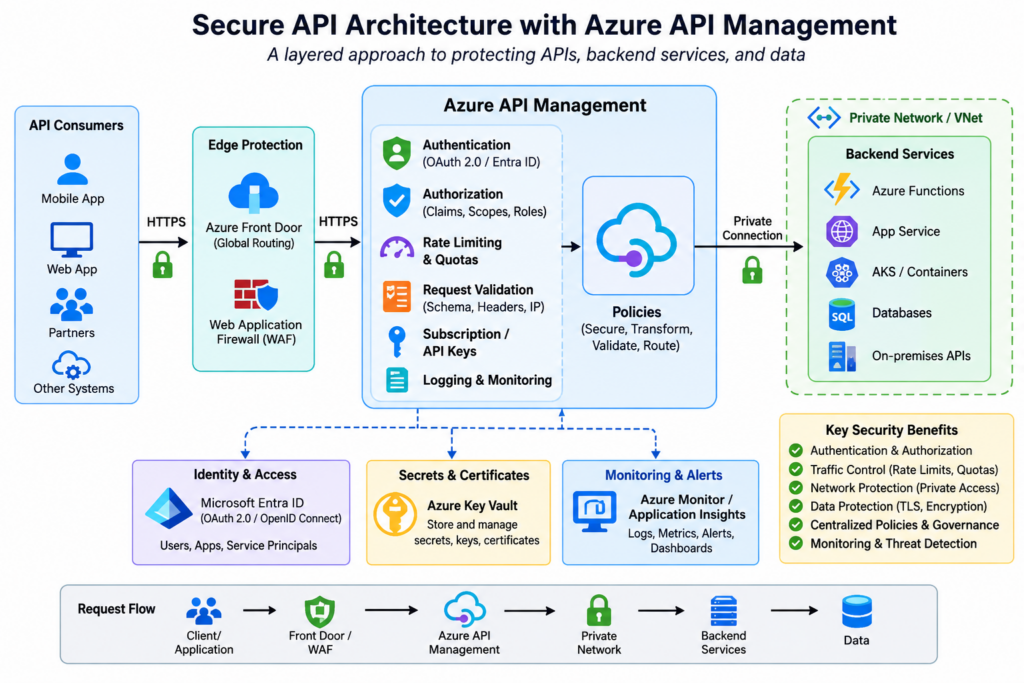
Diagram courtesy of ChatGPT
For most enterprise APIs, a good baseline is:
| Security Area | Recommended Approach |
|---|---|
| Transport | HTTPS/TLS |
| User/application authentication | OAuth 2.0 / Microsoft Entra ID |
| Authorization | Scopes and application roles |
| API consumer management | APIM subscriptions |
| Traffic control | Rate limiting and quotas |
| Network security | Private networking where appropriate |
| Backend exposure | Avoid direct public access |
| Secrets | Azure Key Vault |
| Azure-to-Azure authentication | Managed identities |
| Partner authentication | OAuth 2.0 or mTLS where appropriate |
| Monitoring | Azure Monitor / Application Insights |
| Perimeter protection | WAF where appropriate |
| Input protection | Request and schema validation |
| Security operations | Alerts and centralized monitoring |
A Layered Security Approach
The most important principle is that APIM security is layered. Do not rely on a single control that is expected to protect the entire API.
A strong architecture might use:
Layer 1   Network Security
              ↓
Layer 2   WAF / DDoS Protection
              ↓
Layer 3   HTTPS / TLS
              ↓
Layer 4   Authentication
              ↓
Layer 5   Authorization
              ↓
Layer 6   Rate Limiting
              ↓
Layer 7   Request Validation
              ↓
Layer 8   Backend Authentication
              ↓
Layer 9   Monitoring & Alerting
If one layer fails, other layers still provide protection.
Security Design Checklist
Questions to consider prior to exposing an API through Azure API Management:
- Is the API accessible only through HTTPS?
- How is the caller authenticated?
- How is authorization enforced?
- Are OAuth scopes or application roles being used?
- Are subscription keys required?
- Is rate limiting configured?
- Are quotas required?
- Can the backend be removed from public Internet access?
- Is private networking appropriate?
- Are secrets stored in Key Vault?
- Can managed identity replace stored credentials?
- Are client certificates required for any partners?
- Are incoming requests validated?
- Are sensitive headers removed or controlled?
- Is sensitive information excluded from logs?
- Are authentication failures monitored?
- Are alerts configured for suspicious traffic?
- Is WAF protection required?
- Are certificates and secrets rotated?
- Are APIM policies managed consistently across APIs?
Conclusion
Azure API Management provides much more than a simple API proxy. It serves as a central security enforcement point between API consumers and backend services.
A secure APIM implementation combines strong authentication, granular authorization, network controls, traffic management, request validation, secure secret management, backend protection, and continuous monitoring.
For enterprise environments, a particularly strong pattern is:
Microsoft Entra ID + OAuth 2.0 + APIM policies + private backend connectivity + managed identities + Key Vault + rate limiting + Azure Monitor, with WAF/perimeter protection added where appropriate.
The goal is not simply to make an API difficult to access. The goal is to ensure that the right consumer can access the right API, perform only the operations they are authorized to perform, at an acceptable rate, through a controlled network path, while providing sufficient monitoring to detect and respond to abuse.
DMS Group can assist with securing your Azure APIM platform. Contact us here.

Be the first to comment